


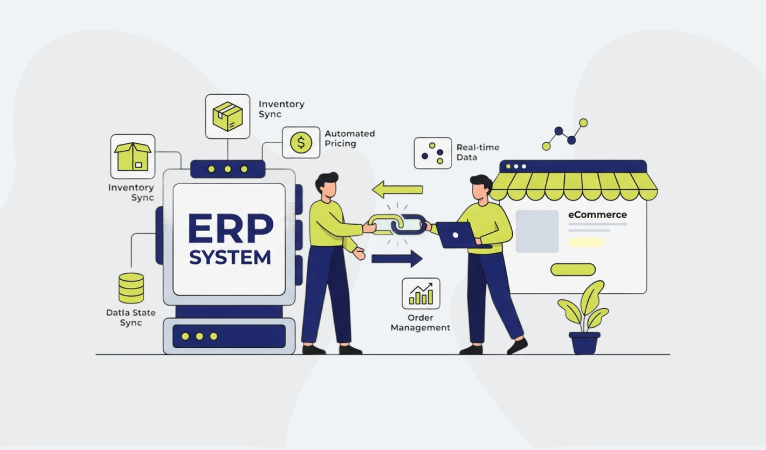


For distributors, ERP integration with eCommerce is not just a technical upgrade. It is a practical way to improve speed, accuracy, and service across the business.
When systems are disconnected, teams waste time on manual tasks. Orders take longer to process, inventory data becomes unreliable, and customer experiences suffer. Axim Commerce helps solve this by connecting your ERP and B2B eCommerce operations in one streamlined environment.
Key benefits at a glance:
- Better operational efficiency
- Real-time data synchronization across systems
- Stronger inventory visibility
- Faster, more accurate order processing
- Support for contract pricing and self-service ordering
Built for distributor-specific workflows, Axim Commerce supports ERP-driven commerce experiences that help businesses modernize their B2B ordering portal, improve customer experience, and move forward with digital transformation.
Axim Commerce makes this integration process smooth, particularly when connecting with robust systems like Epicor Prophet 21. This connection helps automate workflows, minimize mistakes, and keep data consistent across all channels.
In this guide, you will learn the core benefits of integrating your ERP with Axim Commerce, the steps for implementation, and best practices to ensure long-term success.
Understanding ERP Integration with Axim Commerce
Connecting your e-commerce storefront to your backend operations gives you real-time visibility into your business. Axim Commerce provides a secure, fast bridge to your ERP system so data flows automatically.
Seamless Connection with ERP Systems
Modern ERP systems for distribution businesses are often cloud-based and designed to unify inventory management, order processing, customer relationship management (CRM), and financials within a single platform. With a device-independent architecture, these systems give teams access from browsers, tablets, and smartphones, making it easier to stay efficient, connected, and responsive across warehouse and sales operations.
When you integrate your ERP system with Axim Commerce, you gain immediate access to real-time insights across pricing, inventory, orders, and customer data. The integration supports essential operational tasks such as inventory updates, order processing, and warehouse activities, helping teams work faster with fewer errors. With access across browsers, tablets, and smartphones, your staff can stay connected and responsive, giving your business the agility to adapt quickly to changing market demands.
How REST and GraphQL APIs Power the Process
Axim Commerce uses a robust framework of REST and GraphQL APIs to facilitate seamless data flow.
- REST APIs: These allow for structured, standard communication between systems. They handle basic data requests and updates efficiently, keeping data exchanges simple and fast.
- GraphQL APIs: This flexible framework lets the client request only the specific data needed. Limiting data transfer speeds up performance, which is especially useful for complex queries.
These APIs work together to keep product details, pricing, stock levels, and customer information synchronized.
Top Advantages of ERP Integration for B2B eCommerce
Connecting Axim Commerce with your ERP system gives your business a serious competitive edge. Here is how this integration improves your daily operations.
- Boost Operational Efficiency
ERP integration automates order fulfillment and removes the need for manual data entry. Online orders sync instantly with your ERP, which speeds up inventory checks, payment processing, and shipping.
When an order arrives, the system allocates it to the nearest distribution center and optimizes delivery routes. This immediate data transfer helps you fulfill orders faster and build better logistics strategies.
- Elevate the Customer Experience
Accurate product information builds trust. ERP integration ensures your site always displays current product details, images, pricing, and availability. Customers see exactly what is in stock, reducing frustrating cancellations and returns.
The integration also provides real-time shipping cost and tax calculations during checkout. By linking your CRM tools, you can personalize customer interactions, track purchase history, and manage service requests quickly.
- Support Scalability and Growth
As your business grows, your transaction volume increases. A connected ERP system handles complex operations without slowing down. It accommodates multi-company and multi-currency requirements, making it easier to manage diverse locations.
With the ability to handle large product catalogs and high-volume transactions, you maintain robust performance even during peak seasons.
- Ensure Data Accuracy and Better Reporting
Centralizing data in an ERP system eliminates conflicting numbers across departments. Your financial reports, sales analytics, and inventory records become highly reliable.
Advanced reporting tools pull this unified data to offer clear insights. You can track key performance indicators (KPIs) accurately, making it easier to make smart, data-driven decisions.
Implementing ERP Integration with Axim Commerce
Setting up your ERP integration involves critical steps to guarantee accurate data flow. Axim Commerce uses tested methods to connect your systems securely.
Syncing Products and Customers
Axim Commerce pulls data from Prophet 21 and pushes it to your e-commerce site. Changes in the ERP—like a new product launch or a price drop—appear instantly online. This automatic update loop prevents selling out-of-stock items.
Customer data syncs just as smoothly. Account information and purchase histories update instantly across platforms. To maintain high data quality, Axim Commerce applies data mapping and validation rules to catch errors before they impact the user experience.
Real-World Success Stories
Integrating an ERP with your B2B e-commerce platform leads to tangible business results.
One distributor example: A distributor moved from a static website to a dynamic eCommerce platform to improve manual order handling and support long-term growth. By integrating Axim Commerce with its ERP system, the business enabled real-time data synchronization for pricing, tax, inventory, and order information. This helped streamline day-to-day operations, reduce manual work, improve data accuracy, and expand reach into new markets.
Another distributor faced challenges managing high transaction volumes as the business expanded. By integrating its eCommerce platform with Axim Commerce and its ERP system, the company streamlined core workflows and improved the flow of critical business data across systems. This seamless data transfer made it easier to manage complex product offerings, improve order accuracy, and deliver a better overall customer experience.
Best Practices for a Successful Integration
A successful software integration requires careful planning. Follow these best practices to keep the process smooth and secure.
Planning and Preparation
Start by building a solid foundation before you move any data.
- Craft a Clear Strategy: Define what you want to achieve, which systems you need to connect, and the exact results you expect.
- Engage Key Stakeholders: Bring in team members from sales, IT, and customer service early. Good communication builds team support.
- Clean Your Data: Audit your existing records. Remove duplicates and fix errors so you only migrate high-quality data.
- Choose an Integration Method: Decide whether you want a “Big Bang” (all at once) or a phased approach to manage risk.
- Set Success Metrics: Pick KPIs like order processing speed, error rates, and customer satisfaction to measure success.
Continuous Monitoring and Optimization
Your work continues after the system goes live. Regular maintenance keeps the integration running at peak performance.
- Monitor Performance: Use analytics to spot slow load times or data bottlenecks. Fix issues before they affect customers.
- Train Your Team: Teach your staff how to use the new connected systems. Update training materials when software updates occur.
- Prioritize Security: Implement strict security measures to protect customer data. Check your protocols regularly to block vulnerabilities.
- Gather Feedback: Ask your team and your customers about their experience. Use this feedback to refine your workflows.
Conclusion: The Future of B2B eCommerce and ERP Integration
Integrating your ERP system with Axim Commerce transforms the way you do business. It drives efficiency, creates better shopping experiences, and provides the scalable infrastructure you need to grow. By synchronizing inventory, orders, and customer details, you eliminate manual errors and respond faster to market changes.
B2B e-commerce will lean even heavier into automation. You can expect artificial intelligence and machine learning to offer predictive insights directly within your ERP dashboard. Real-time data processing will become the baseline standard for operations.
To start improving your operations, audit your current data workflows. Identify where manual entry slows your team down, and use those insights to map out your ERP integration strategy.
