


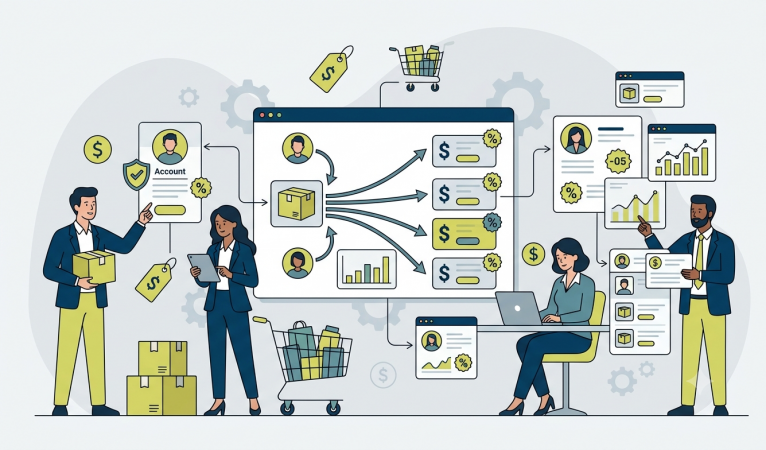


Quick answer: Customer specific pricing lets B2B distributors set unique prices, discounts, and terms for individual accounts or customer groups instead of applying one universal price list. It protects margins, matches negotiated deals, and supports sales rep relationships while still allowing self service ordering online. Platforms like Axim Commerce make this possible by connecting ERP pricing logic directly to the storefront experience, giving distributors a fully integrated B2B ecommerce site without the technical overhead.
Pricing in B2B commerce has never been simple. Unlike a retail shopper who sees the same price as everyone else, a B2B buyer expects the rate they negotiated with their sales rep, the volume discount they earned last quarter, and the contract terms written into their agreement. When distributors move this complexity online, the stakes rise fast: get B2B ecommerce pricing wrong, and you either erode margin or damage customer trust.
This guide walks through everything a distributor needs to understand about customer specific pricing in B2B eCommerce, from foundational terminology to implementation patterns, governance, and future trends. Along the way, we’ll show how a platform purpose built for distribution, such as Axim Commerce, turns these concepts into a working reality rather than a theoretical framework.
Introduction to Customer Specific Pricing in B2B eCommerce
Why Pricing Is More Complex in B2B than B2C
B2C pricing is largely uniform. Every shopper sees the same price for the same product, adjusted only by promotions or loyalty programs. B2B ecommerce pricing operates on an entirely different model. Each customer may have negotiated rates, volume commitments, contract terms, or industry specific discounts. A distributor might sell the same part to twenty different customers at twenty different net prices, depending on relationship history, order volume, and payment terms.
This complexity multiplies when you factor in product hierarchies, regional variation, and currency differences. A B2B ecommerce site that cannot account for this granularity will force sales teams back to spreadsheets and phone calls, defeating the purpose of going digital. The simplest pricing strategies that work fine in B2C simply cannot meet the demands of B2B purchases.
How Customer Specific Pricing Fits into a Distributor’s Strategy
Customer specific pricing isn’t a feature bolted onto a B2B ecommerce site. It is the foundation that makes B2B ecommerce viable for distributors. Without it, a distributor cannot safely move existing customers online, because those customers already expect their negotiated rates to follow them into the digital channel. Axim Commerce was built with this reality in mind, treating pricing as core infrastructure rather than an afterthought.
Key Outcomes Distributors Can Achieve with Tailored Pricing
Distributors who implement customer specific pricing effectively typically see higher conversion rates, improved site performance from optimized pricing lookups, and stronger customer retention. Sales reps gain more time to focus on relationship building instead of manually quoting every order, and finance teams gain clearer visibility into margin performance across accounts.
Core Concepts and Terminology
Customer Specific Pricing vs. Standard Pricing
Standard pricing applies a single list price to every buyer. Customer specific pricing overrides that list price for a particular account, group, or contract. In practice, most distributors use a hybrid: a default catalog price acts as a fallback, while specific overrides apply wherever a negotiated rate exists. Understanding the difference between these two approaches is essential before designing any B2B ecommerce pricing strategy.
Contract Pricing, Matrix Pricing, and List Pricing Explained
Contract pricing ties a specific price to a formal agreement, often with a defined start and end date. Matrix pricing applies rules across combinations of variables, such as customer group and product category. List pricing is the published, default rate used when no other rule applies, functioning as the baseline from which all other B2B ecommerce pricing strategies are measured. Understanding how these interact is essential, because most pricing engines apply them in a specific order of precedence.
Price Levels, Tiers, and Segments
Price levels group customers by purchasing behavior, such as wholesale, retail, or preferred partner. Tiers often reflect volume commitments, where higher tiers unlock better rates. Segments may combine both, along with geography or industry vertical, to create a more nuanced structure across the customer base.
Rebates, Discounts, and Surcharges
Rebates are retroactive price adjustments, often tied to volume targets met over a period. Discounts are applied at the point of sale, either as a percentage or flat amount. Surcharges add cost, commonly for expedited shipping, hazardous materials, or small order fees. Each of these needs to be represented clearly to the customer so pricing feels transparent rather than arbitrary.
Net Price vs. Gross Price vs. Pocket Price
Gross price is the catalog price before adjustments. Net price is what the customer actually pays after discounts and rebates. Pocket price is what the distributor actually keeps after all costs, including freight and rebates paid out. Distributors that only track gross and net prices often miss margin leakage that only becomes visible at the pocket price level.
Common B2B Customer Pricing Models for Distributors
Customer Based Price Lists
Each customer is assigned a dedicated price list reflecting their unique negotiated terms. This model offers maximum flexibility but can become difficult to manage at scale without strong tooling. For distributors handling a large volume of B2B purchases across many accounts, automation is essential.
Segment Based and Tiered Pricing Structures
Rather than pricing every customer individually, distributors group accounts into segments or tiers, applying consistent pricing rules within each group. Among the simplest pricing strategies available, tiered structures reduce administrative overhead while still allowing meaningful differentiation across the customer base.
Volume Based and Quantity Break Pricing
Prices decrease as order quantity increases, encouraging larger B2B purchases. Quantity breaks are often displayed directly on product pages so buyers can see the incentive to order more, making this one of the most effective B2B ecommerce pricing strategies for driving average order value.
Contract and Agreement Based Pricing
Prices are locked in for the duration of a formal agreement, often used for large accounts or long term supply relationships. This model requires careful tracking of contract start and end dates to ensure B2B ecommerce pricing stays consistent with what was promised.
Project and Job Specific Pricing
Some distributors, particularly in construction or industrial supply, price materials for a specific project rather than a standing customer relationship. This requires flexible, temporary pricing rules tied to a job number, separate from standard catalog prices.
Cost Plus and Margin Based Pricing Models
Price is calculated as cost plus a defined margin percentage, which automatically adjusts as underlying costs fluctuate. This protects margin during periods of cost volatility but requires accurate, real time cost data. It is one of the more reliable B2B ecommerce pricing strategies for distributors operating in commodity markets.
Value Based Pricing
Value based pricing sets prices according to the perceived value a product or service delivers to a specific customer, rather than simply marking up cost. In B2B commerce, this approach works well for specialized or proprietary products where the customer’s willingness to pay reflects the business outcome they receive. Distributors using value based pricing need strong account knowledge and a B2B ecommerce site capable of surfacing the right price for the right customer at the right time.
Manufacturer Suggested and Pass Through Pricing
Distributors selling manufacturer branded products may need to honor minimum advertised pricing or pass through manufacturer set rates, layering another constraint on top of internal pricing logic.
Business Drivers for Customer Specific Pricing in Distribution
Protecting Margins in a Highly Competitive Market
Distribution margins are often thin. Customer specific pricing allows distributors to protect margin on price sensitive accounts while offering competitive rates where necessary to win or retain business. Without the ability to show different prices to different customers, a B2B ecommerce site becomes a liability rather than an asset.
Meeting Customer Expectations for Negotiated Deals
B2B buyers expect their negotiated rate to appear automatically, without needing to call a rep or request a quote for every order. Failing to deliver this on a B2B ecommerce site erodes trust in the digital channel quickly.
Supporting Sales and Key Account Management
Sales reps rely on the ability to adjust pricing for strategic accounts. A platform that supports rep assisted ordering, like Axim Commerce, lets reps manage their assigned companies and place orders on their behalf, preserving the relationship based selling model distributors depend on.
Differentiation from Competing Distributors
In commoditized markets, pricing flexibility itself becomes a competitive advantage. Distributors who can offer different prices to different customers, quickly and accurately, retain business that a rigid pricing model would lose.
Enabling Self Service While Preserving Relationship Pricing
Customers increasingly want to place routine reorders online without picking up the phone. Customer specific pricing makes this possible by ensuring the online experience mirrors the negotiated relationship, rather than forcing a choice between self service convenience and personalized pricing.
Organizational and Data Foundations
Master Data Requirements for Pricing
Customer Master and Customer Groups
Accurate customer records, including group assignments, are the backbone of any pricing engine. Errors here cascade into every price calculation downstream, affecting catalog prices, contract rates, and volume discounts simultaneously.
Product Master, Categories, and Attributes
Products need consistent categorization and attributes to support hierarchy based pricing rules, such as discounts applied across an entire product category rather than individual SKUs.
Price Lists, Cost Data, and Currency Management
Cost data must stay current to support margin based and value based pricing, and currency management becomes critical for distributors serving international accounts.
Pricing Governance, Ownership, and Workflows
Someone within the organization needs clear ownership of pricing policy, including who can approve new customer specific rates and how exceptions get documented. Without clear governance, B2B ecommerce pricing strategies quickly become inconsistent.
Data Quality, Duplication, and Version Control Challenges
Duplicate customer records or outdated price lists create inconsistent pricing that damages customer trust. Version control ensures teams know which price list is currently active.
Integrating ERP, CRM, and eCommerce Data
Pricing data typically lives in the ERP, customer relationship context lives in the CRM, and the B2B ecommerce site needs both in real time. Axim Commerce integrates directly with existing ERP systems, so pricing logic already established in back office systems carries through to the web store without duplication of effort.
Designing a Customer Specific Pricing Strategy
Segmentation of Customers and Accounts
Effective segmentation groups customers by shared characteristics, such as industry, volume, or geography, to reduce the number of unique pricing rules that need to be maintained individually. Segmentation is also the starting point for any value based pricing approach in B2B commerce.
Defining Pricing Policies and Guardrails
Policies should define minimum discount thresholds, approval requirements, and floor prices to prevent uncontrolled margin erosion across B2B purchases.
Deciding Which Customers Get Special Pricing
Not every account needs a custom price list. Distributors should reserve individualized pricing for accounts where the volume or strategic value justifies the administrative overhead, defaulting others to catalog prices or tier based rules.
Balancing Flexibility and Standardization
Too much flexibility creates administrative chaos. Too much standardization loses the deals that keep major accounts loyal. The right balance depends on account size, competitive pressure, and internal resources.
Handling Legacy Pricing and Historical Exceptions
Many distributors carry years of one off pricing exceptions. Migrating to a new B2B ecommerce site is an opportunity to audit these exceptions and decide which still make business sense.
Pricing Structures and Rules in B2B eCommerce
Hierarchies of Pricing Rules and Precedence
Customer Specific Price vs. Customer Group Price
When both exist, the individual customer price should typically override the group price, since it reflects a more specific negotiated agreement. This precedence logic is fundamental to any B2B ecommerce pricing strategy that assigns different prices to different customers.
Contract Price vs. Promotion vs. Default Price
A clear precedence order (often contract price, then promotion, then default catalog price) prevents confusing or inconsistent pricing outcomes at checkout.
Pricing Based on Product Hierarchies
Discounts applied at the category or brand level reduce the need to configure pricing for every individual SKU, making this one of the more practical B2B ecommerce pricing strategies at scale.
Configuring Discounts, Markups, and Fees
Flexible rule configuration allows distributors to apply percentage discounts, flat markups, or conditional fees without custom development for every scenario.
Time Bound and Conditional Pricing Rules
Seasonal promotions, contract expirations, and limited time offers all require pricing rules that automatically activate and deactivate based on date ranges, keeping B2B ecommerce pricing accurate without manual intervention.
Currency, Region, and Channel Specific Rules
Distributors operating across regions need pricing logic that accounts for currency conversion and region specific tax or regulatory requirements.
Axim Commerce Capabilities for Customer Specific Pricing
Axim Commerce was built specifically to address the pricing complexity that B2B distributors face every day. Rather than adapting a B2C platform to fit B2B needs, Axim Commerce treats customer specific pricing as a core capability, not an add on. Here is what that means in practice.
Customer Specific Price Lists
Axim Commerce allows distributors to assign dedicated price lists to individual customers or customer groups. When a buyer logs into the B2B ecommerce site, their specific prices load automatically, eliminating the need for manual lookups or rep intervention on routine reorders.
Multiple Pricing Models in One Platform
Whether you operate on contract pricing, volume based pricing, value based pricing, cost plus, or tiered structures, Axim Commerce supports all of these models within a single platform. Distributors can assign different prices across different customers, product categories, or ordering scenarios without managing separate systems for each pricing model.
ERP Integrated Pricing Engine
Axim Commerce integrates directly with existing ERP systems, ensuring that catalog prices, contract rates, and discount rules stay synchronized between the back office and the B2B ecommerce site. There is no need to maintain separate price lists in multiple places. Changes made in the ERP flow through to the storefront automatically, keeping pricing accurate across all B2B purchases.
Sales Rep Assisted Ordering with Pricing Access
Sales reps within Axim Commerce can log in, view their assigned accounts, and place orders on behalf of those customers at the correct customer specific pricing. This preserves the relationship based selling model while giving customers the flexibility to self serve when they prefer.
Login Based Catalog Personalization
Axim Commerce personalizes both pricing and catalog visibility based on the logged in account. A customer only sees the products available to them, priced at their negotiated rates. Guest or prospect visitors see either catalog prices or no pricing at all, depending on the distributor’s preference.
Approval Workflows and Pricing Guardrails
For distributors that need governance controls, Axim Commerce supports minimum margin thresholds, floor price enforcement, and approval workflows for pricing exceptions. Sales reps can see margin impact before applying discounts, ensuring that B2B ecommerce pricing decisions stay within policy.
Punchout Catalog Support
For enterprise B2B buyers that purchase through procurement systems, Axim Commerce supports punchout catalog integration. This ensures customer specific pricing carries through into the buyer’s own procurement workflow, making Axim Commerce a genuinely seamless fit for complex B2B commerce environments.
Scalable Price List Management
As distributor customer bases grow, Axim Commerce provides bulk management tools for updating and auditing price lists at scale. Distributors can update thousands of customer specific prices at once without manual, record by record editing.
ERP and Back Office Integration Patterns
Direct ERP Pricing Calls from the Web Store
This pattern guarantees pricing accuracy by pulling prices directly from the ERP at the moment of viewing or checkout, though it depends on ERP responsiveness.
Replicating Price Data into the eCommerce Platform
Replicating price data into the storefront database improves speed but requires reliable synchronization to avoid stale catalog prices appearing on the B2B ecommerce site.
Hybrid Models and Caching Strategies
Many distributors use a hybrid approach, caching frequently accessed prices while calling the ERP for less common scenarios. Axim Commerce supports flexible integration patterns that let distributors balance speed and accuracy according to their own infrastructure and ERP capabilities.
Synchronizing Contracts, Discounts, and Rebates
Contracts and rebate programs need consistent synchronization schedules so that online pricing never contradicts what a customer was promised by their sales rep.
Dealing with Latency, Timeouts, and Failover
A robust integration plan includes fallback logic for when the ERP is slow or unavailable, ensuring the B2B ecommerce site still functions without exposing customers to incorrect pricing.
Margins, Profitability, and Price Optimization
Cost Visibility and Margin Controls for Sales
Sales reps need visibility into margin impact when adjusting prices, preventing well intentioned discounts from silently destroying profitability across B2B purchases.
Minimum Margin and Floor Price Enforcement
System enforced floor prices prevent reps or automated rules from dropping below an acceptable margin threshold.
Using Analytics for Price Realization and Leakage
Analytics tools help distributors identify where negotiated prices, rebates, and discounts are quietly eroding pocket price across the customer base.
Dynamic Pricing and Market Responsive Adjustments
Some distributors are beginning to adjust prices based on market conditions or competitor movement, combining elements of value based pricing with real time market awareness, though this requires careful governance to avoid customer confusion.
Integrating Pricing with Revenue Management and CPQ
Configure, price, quote (CPQ) tools extend B2B ecommerce pricing logic into complex, multi line quotes, ensuring consistency between quoted prices and what eventually appears on the invoice.
User Experience and Customer Communication
Presenting Personalized Prices Online
Customers should see their specific price clearly on the B2B ecommerce site, ideally alongside the standard catalog price so the value of their negotiated rate is visible at a glance.
Handling Price Availability for Prospect or Guest Users
Distributors often hide pricing entirely from unauthenticated visitors, or show generic catalog prices, reserving negotiated rates for logged in accounts.
Explaining Discounts, Savings, and Contract Terms
Clear labeling, such as “your contract price” or “volume discount applied,” builds trust and reduces support inquiries about pricing discrepancies.
Managing Customer Expectations When Prices Change
Proactive communication about upcoming price changes, especially for contract renewals, prevents unpleasant surprises that can damage customer relationships.
Aligning Web Pricing with Sales Rep Quotes
B2B ecommerce pricing shown online must match what sales reps quote over the phone or in person. Any inconsistency undermines confidence in the digital channel.
Operational Challenges and How to Overcome Them
Managing Thousands of Exceptions and Special Deals
Bulk editing tools and clear segmentation reduce the burden of managing large volumes of individual pricing exceptions across a high volume B2B ecommerce site.
Price Conflicts and Dispute Resolution
Clear precedence rules and audit trails make it faster to resolve disputes when a customer questions why they were charged a particular price rather than their expected rate.
Avoiding Channel Conflict Between eCommerce and Sales
Reps should never feel threatened by the online channel. Platforms like Axim Commerce support rep assisted ordering, so sales reps remain central to the buying process even as customers gain self service options.
Maintaining Performance with Large Pricing Datasets
Efficient indexing and caching strategies keep page load times fast even when a distributor manages hundreds of thousands of customer specific price points across a B2B ecommerce site.
Security and Access Control for Sensitive Pricing Data
Negotiated pricing is confidential business information. Role based access controls ensure only authorized users, whether internal staff or the specific customer, can view sensitive rates.
Governance, Compliance, and Risk Management
Approval Workflows for Price Changes
Formal approval chains for new pricing exceptions prevent unauthorized discounting and keep B2B ecommerce pricing decisions accountable.
Audit Trails and Version History for Pricing Decisions
A complete history of who changed what pricing, and when, supports both internal accountability and external compliance requirements.
Compliance with Competition and Pricing Regulations
Distributors must ensure pricing practices comply with relevant antitrust and fair pricing regulations, particularly when dealing with manufacturer pricing restrictions or value based pricing in regulated categories.
Managing Confidential and Strategic Pricing Information
Strict data governance prevents sensitive contract terms from being exposed to competitors or unauthorized internal users.
Change Management and Adoption
Educating Sales Teams on the New Pricing Model
Reps need clear training on how the new system reflects, rather than replaces, the pricing relationships they’ve built with customers. The goal is to show that different prices for different customers are now handled automatically, not manually.
Aligning Incentives and Compensation with Pricing Goals
Compensation structures should reward margin performance, not just revenue volume, to reinforce disciplined B2B ecommerce pricing behavior.
Onboarding Customers to the eCommerce Experience
Customers need clear communication showing that their negotiated pricing will follow them onto the B2B ecommerce site, removing hesitation about switching to self service ordering.
Iterative Rollout and Pilot Programs
Starting with a pilot group of accounts allows distributors to validate pricing accuracy before a full rollout, reducing risk of widespread errors.
KPIs and Metrics for Measuring Success
Revenue, Margin, and Profitability Metrics
Track overall revenue alongside margin percentage to ensure growth across B2B purchases doesn’t come at the expense of profitability.
Customer Adoption and Self Service Utilization
Measure how many customers actively use the B2B ecommerce site for reorders versus relying on phone or rep assisted orders.
Price Realization, Discounting, and Leakage Metrics
Compare catalog prices to actual pocket price realized to identify where discounting is eating into expected margin.
Operational Efficiency and Error Reduction
Track reductions in manual quoting time and pricing errors as evidence that the new B2B ecommerce pricing strategy is delivering operational value.
Future Trends in B2B Customer Specific Pricing
Artificial Intelligence and Machine Learning in Pricing
AI driven pricing models are beginning to recommend optimal discounts based on historical purchase behavior and price elasticity, helping distributors build smarter B2B ecommerce pricing strategies that adapt over time.
Real Time Market and Competitor Aware Pricing
Distributors are exploring tools that blend value based pricing principles with real time competitor data, adjusting prices dynamically based on market conditions, though adoption remains early stage in most of the industry.
Customer Portals, CPQ, and Self Negotiation Tools
Advanced portals increasingly let customers request custom quotes or negotiate volume pricing directly on a B2B ecommerce site, reducing the manual back and forth traditionally handled by phone.
Embedded Pricing in Partner and Marketplace Channels
As distributors expand into marketplace and partner channels, customer specific pricing logic needs to extend beyond the primary storefront to remain consistent everywhere a customer might make B2B purchases.
Step by Step Roadmap for Distributors
- Assess the current state of pricing and systems – Start with an honest audit of existing price lists, catalog prices, contracts, and exceptions, along with the current state of ERP and CRM integration.
- Define the target pricing model and architecture – Decide which combination of segment, contract, value based, and volume based pricing best fits your customer base, and document the precedence rules that will govern conflicts.
- Select technology and an integration approach – Choose a platform built for distribution specific needs. Axim Commerce offers native support for customer specific pricing, multi warehouse fulfillment, and ERP integration, reducing the custom development typically required to support complex B2B ecommerce pricing at scale.
- Implement in phases and improve continuously – Roll out pricing changes in phases, starting with a pilot group, and continuously refine rules based on feedback from both customers and sales teams.
Conclusion and Key Takeaways for Distributors
Customer specific pricing is not a nice to have feature for B2B distributors. It is the mechanism that makes moving to B2B ecommerce possible without breaking the trust built through years of negotiated relationships. Getting it right requires clean master data, clear governance, thoughtful segmentation, and a B2B ecommerce site capable of translating complex ERP pricing logic into a fast, accurate online experience.
Distributors who invest in getting this foundation right see measurable gains: higher conversion on B2B purchases, better margin control, and stronger adoption of self service ordering, all while preserving the sales rep relationships that remain central to B2B commerce. Platforms purpose built for distribution, such as Axim Commerce, remove much of the technical burden by offering native support for customer specific price lists, contract pricing, value based pricing configurations, rep assisted ordering, and ERP integration from the start.
The distributors who succeed in this space treat B2B ecommerce pricing not as a technical afterthought, but as a strategic capability worth getting right from day one. Ready to see it in action? Schedule a demo of Axim Commerce.
Frequently Asked Questions
What is customer specific pricing in B2B eCommerce?
Customer specific pricing is a pricing model where individual B2B customers or customer groups receive different prices, discounts, or contract terms rather than a single universal catalog price, reflecting the negotiated relationships common in B2B commerce.
How much does it cost to implement customer specific pricing?
Costs vary depending on the complexity of existing pricing exceptions and the B2B ecommerce site chosen. Platforms with native B2B ecommerce pricing support, such as Axim Commerce, typically reduce implementation costs by minimizing the need for custom development.
How long does it take to roll out customer specific pricing online?
Timelines depend on data quality and integration complexity, but a phased rollout starting with a pilot group of accounts often allows distributors to validate accuracy within a few months before a full launch.
What are the risks of getting customer specific pricing wrong?
Poorly managed B2B ecommerce pricing can lead to margin erosion, customer disputes, and damaged trust if online prices don’t match what sales reps have negotiated. Strong governance and audit trails help mitigate these risks.
Who should use customer specific pricing versus standard tiered pricing?
Distributors with a smaller number of high value accounts often benefit from individualized customer specific pricing, while those serving many similar customers may find segment or tier based pricing, one of the simplest pricing strategies, more manageable at scale.
What makes Axim Commerce different for B2B ecommerce pricing?
Axim Commerce was built specifically for B2B distributors, offering native support for customer specific price lists, ERP integration, sales rep assisted ordering, punchout catalog support, and multiple B2B ecommerce pricing strategies within a single platform, without the need for extensive custom development.
