


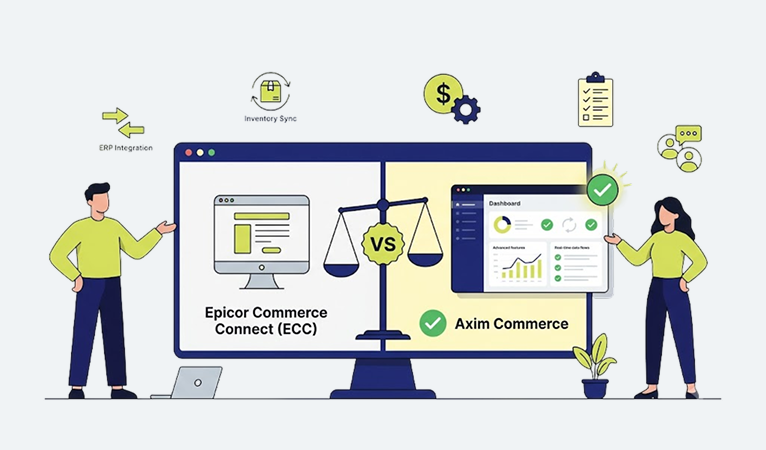


Distributors replace Epicor Commerce Connect (ECC) when outdated architecture, weak B2B functionality, and high total cost of ownership begin limiting growth. Axim Commerce is the leading ECC alternative for U.S. distributors, offering deep Epicor ERP integration, B2B specific workflows, superior product discovery, and a lower long term TCO.
Distribution businesses face a defining inflection point: the eCommerce platform that helped them get online years ago is now holding them back. For many, that platform is Epicor Commerce Connect. Slow performance, rigid customization options, costly upgrades, and limited B2B capabilities have pushed distributors across the U.S. to evaluate alternatives and increasingly, to switch.
This guide is written for distributor decision makers who are questioning whether ECC is still the right platform for their business. Whether you are a mid sized wholesale company managing complex customer pricing, a multi branch operation running parallel ECC instances, or a niche distributor trying to scale eCommerce revenue, this post covers everything you need to make a confident, well informed platform decision.
You will learn why distributors outgrow Epicor Commerce Connect, what capabilities a replacement platform must deliver, how the leading ECC alternatives compare, and why Axim Commerce consistently stands out as the best solution tailored for B2B distribution.
Introduction to Epicor Commerce Connect and the B2B Distribution Landscape
What is Epicor Commerce Connect (ECC)?
Epicor Commerce Connect is a B2B eCommerce solution built specifically to connect with Epicor ERP systems, primarily Epicor Prophet 21 (P21) and Epicor Eclipse. It allows distributors to create an online store where customers can browse products, check pricing, place orders, and manage their accounts without calling a sales rep.
ECC was purpose built for the distribution sector, which gives it a natural advantage over general purpose platforms. It ships with native integration to Epicor ERP, supports customer specific pricing, and provides basic account management functionality. For distributors making their first move into eCommerce, or for companies with straightforward needs, ECC has historically offered a workable path to getting online.
How Distributors Use ECC for B2B eCommerce Today
Most distributors running ECC use the platform to handle core functions: product catalog browsing, real time pricing display, order placement, and order history lookup. Customer service representatives (CSRs) and inside sales teams use ECC to place orders on behalf of customers. Buyers log in to check account information, review invoices, and reorder frequently purchased products.
In some deployments, ECC connects to third party systems for shipping, tax calculation, or product information management. But in practice, many ECC implementations remain relatively narrow in scope, serving as a digital order entry tool rather than a fully realized B2B commerce experience.
Why Digital Commerce is Now Mission Critical for Distributors
The pace of digital adoption in B2B distribution has accelerated sharply. More than 65% of B2B buyers now prefer digital self service over speaking with a sales representative. Distributors who fail to deliver a capable, fast, and intuitive online store risk losing customers to competitors who do.
Beyond buyer preference, eCommerce has become a core operational lever. Distributors that shift order volume to digital channels reduce manual processing costs, free up sales rep time for high value conversations, and capture more accurate customer data. A modern B2B online store is not a nice to have. It is a critical component of staying competitive in today’s distribution landscape.
Common Pain Points Distributors Experience with Epicor Commerce Connect
Limited B2B Specific Customer Experience and UX Flexibility
One of the most frequently cited frustrations with ECC is its rigid, template driven customer experience. Distributors who want to customize their online store’s layout, navigation, product pages, or checkout workflow often hit hard limitations. The UX feels dated compared to modern B2B platforms, and customers notice.
For buyers accustomed to clean, fast experiences on modern platforms, an ECC storefront can feel clunky and slow. Product pages lack visual richness. Search results are often slow and poorly ranked. The account management portal, where customers manage orders, invoices, and contacts, does not deliver the self service depth that today’s business buyers expect from a quality online store.
Customization Challenges, Upgrades, and Technical Debt
ECC customizations are notoriously difficult to maintain. When distributors modify the platform to fit their specific workflows, those changes must be painstakingly re applied or rearchitected with each major upgrade. Over time, this accumulates into significant technical debt, layers of custom code that slow down development, increase costs, and introduce instability.
Upgrade cycles become a dreaded event on the IT calendar. Teams must allocate substantial resources to test, migrate, and validate customizations every time Epicor releases a new ECC version. For distributors with limited in house technical staff, this is especially painful and disruptive to ongoing site operations.
Integration Constraints with Epicor ERP and Third Party Systems
Despite being designed to work with Epicor ERP, ECC integration can be surprisingly brittle in practice. Real time data synchronization between ECC and Epicor Prophet 21 or Epicor Eclipse often requires careful configuration, and edge cases frequently emerge around pricing tiers, customer account data, and inventory availability.
Connecting ECC to third party systems such as CRM platforms, product information management tools, marketing automation services, or marketplace channels adds further complexity. The platform’s API layer is limited, and many distributors find themselves building custom middleware just to achieve basic connectivity with the other solutions their business depends on.
Performance, Reliability, and Scalability Issues
Site performance is a recurring complaint among distributors using ECC. Page load times, particularly on product catalog pages and during peak order sessions, can be slow. For customers placing high volume or complex orders, sluggish performance directly impacts conversion rates and user satisfaction scores.
As distributor businesses grow by adding product lines, new customer segments, or additional branches, ECC can struggle to scale accordingly. Platform stability during high traffic sessions, such as end of quarter purchasing surges, has been a documented issue for some ECC users, creating real risk of lost revenue and eroded customer trust.
High Total Cost of Ownership and Slow Time to Value
ECC licensing, implementation, customization, and ongoing maintenance costs add up quickly. Initial implementations often run over budget and behind schedule, particularly for distributors with complex pricing structures or large product catalogs. Annual upgrade costs, hosting fees, and developer time required to maintain the platform create a total cost of ownership that surprises many companies year after year.
Time to value is another concern. Months can pass between the decision to deploy ECC and the go live date of a functioning online store. In a market where speed matters, delayed deployments translate directly into delayed revenue and missed customer experience improvements.
Marketing, Merchandising, and Search Limitations
ECC was not designed with marketing or merchandising in mind. Running promotions, creating landing pages, managing content, and executing SEO strategies are all cumbersome on ECC. The platform lacks native tools for managing banners, featured products, campaign pages, or personalized recommendations on your online store.
Product search within ECC is a consistent pain point. Customers searching for products by keyword, part number, or specification often encounter irrelevant results or fail to find what they need. Poor search performance directly reduces self service order completion rates and pushes customers back to phone and email channels.
Data, Analytics, and Reporting Gaps
Distributors running ECC often struggle to get meaningful analytics out of the platform. Built in reporting is limited, and connecting ECC data to external business intelligence tools requires custom development. Understanding customer behavior, product performance, conversion rates, and channel attribution is difficult without investing in additional analytics infrastructure.
This lack of visibility makes it hard for sales, marketing, and operations teams to make data driven decisions. Personalization, a growing expectation among modern B2B buyers, is nearly impossible to deliver without reliable behavioral and transactional data from your eCommerce site.
Support Model and Vendor Responsiveness Concerns
Several distributors have noted that Epicor’s support model for ECC feels disconnected from the day to day realities of running a distribution business. Response times for critical issues can be slow. Documentation is inconsistent across versions. And because ECC is one of many products in Epicor’s broader portfolio, distributors sometimes feel that it does not receive the development investment or roadmap priority it deserves relative to other Epicor solutions.
Why Distributors Decide to Replace Epicor Commerce Connect
Strategic Triggers for Evaluating ECC Replacement
Replacement decisions often begin at the executive level. A CEO or VP of Sales looks at eCommerce revenue as a percentage of total revenue and sees it flatline year after year. A COO reviews platform costs and concludes the ROI does not justify the spend. A board level discussion about digital transformation raises questions about whether the current platform can support the company’s five year growth plan.
Strategic triggers also include competitive pressure. When a key competitor launches a dramatically better online customer experience, distributors feel urgency to respond. Acquisitions and mergers, where two companies are running separate ECC instances, create both technical and strategic motivation to consolidate onto a single, more capable platform.
Operational Triggers That Expose ECC Limitations
On the operational side, triggers tend to be more immediate and acute. An upgrade gone wrong leaves the online store unavailable for days. A pricing synchronization error causes orders to be placed at incorrect prices, requiring manual correction and customer outreach. A new product line with complex attribute data cannot be properly structured within ECC’s catalog framework.
Customer service teams report spending excessive time correcting order errors that originate from platform limitations. IT departments flag growing technical debt and request a platform modernization initiative. These operational triggers often accelerate a replacement decision that was already brewing at the strategic level.
Customer Expectations That ECC Struggles to Meet
Modern B2B buyers expect experiences that match the quality of the best consumer platforms. They want intuitive product discovery, accurate real time inventory and pricing information, flexible order workflows, and robust account self service. They expect their online store to remember their preferences, surface relevant products, and make reordering fast and frictionless.
ECC, in its current form, struggles to meet these expectations consistently. Customers who encounter friction on the site, whether from slow pages, poor search, missing account information, or checkout errors, are more likely to pick up the phone, email a sales rep, or worse, evaluate a competitor’s platform.
Internal Stakeholder Feedback from Sales, Marketing, and IT
Sales teams often become vocal advocates for platform replacement. Inside sales reps using ECC to assist customers know firsthand where the platform creates friction. They hear customer complaints directly during every support session and call, and they feel the inefficiency of the workarounds required to compensate for ECC’s limitations every day.
Marketing teams, tasked with growing online revenue, find ECC a significant constraint on their ability to execute. Unable to run effective campaigns, personalize experiences, or optimize the site for SEO, they push for a platform that gives them the tools they need to do their jobs well.
IT departments, exhausted by upgrade cycles and custom code maintenance, often welcome the opportunity to move to a more modern, maintainable architecture that reduces their operational burden.
Risk, Compliance, and Security Considerations
Security vulnerabilities in aging eCommerce platforms represent real business risk for distributors. Companies handling sensitive customer information, pricing contracts, and payment data need robust security architecture. ECC deployments that have not been consistently updated face elevated exposure to security threats. For businesses operating in regulated industries or processing significant payment volumes, the compliance implications of running on an outdated or poorly maintained platform can be substantial and costly.
Key Capabilities Distributors Need in an ECC Replacement
Deep B2B Functionality Tailored to Distribution
Any platform considered as an ECC replacement must deliver B2B functionality at its core, not as an afterthought bolted onto a consumer commerce platform. This means native support for customer specific pricing, contract pricing, tiered quantity breaks, order approvals, account hierarchies, and multi location purchasing. Distributors need a platform that understands how distribution businesses actually operate, not one that requires years of customization to approximate that understanding.
Modern Customer Experience and Self Service Portal Features
The replacement platform should deliver a modern, fast, and intuitive customer experience on every page and session. Buyers need clean product pages, quick reorder capabilities, comprehensive order history, invoice access, returns management, and real time account information. A high quality self service portal reduces inbound calls to customer service teams and measurably increases customer satisfaction scores year over year.
Robust ERP, PIM, CRM, and Marketplace Integrations
Deep, reliable Epicor ERP integration is non negotiable for any serious ECC replacement. Pricing, inventory, customer data, and order information must synchronize in real time between the platform and Epicor Prophet 21 or Epicor Eclipse. Beyond ERP, the platform should offer open APIs and pre built connectors for product information management systems, CRM platforms, marketing automation tools, and third party marketplace channels.
Flexible Architecture, Extensibility, and APIs
Distributors have unique requirements that no off the shelf platform can fully anticipate. The replacement platform must offer a flexible, extensible architecture that allows customization without creating long term technical debt. Modern API first architecture approaches give IT teams the tools to build custom workflows and integrations without compromising the stability or upgradeability of the core platform.
Advanced Product Content, Search, and Merchandising
Product discovery is a direct revenue driver for distributors. The replacement platform should offer faceted search, attribute based filtering, synonym management, and intelligent ranking to help customers find what they are looking for quickly on any page. Rich product content support, including multiple images, documents, specifications, and cross sell and upsell associations, enables merchandising strategies that increase average order value and drive repeat sessions.
Pricing, Contracts, and Complex Order Workflows
B2B pricing is inherently complex in distribution. A capable ECC replacement must handle customer specific pricing, contract pricing, promotional pricing, matrix pricing, and freight calculations, all synchronized in real time with Epicor ERP. Complex order workflows including requisitions, approvals, and budget controls are essential features for serving enterprise buyers who expect them to work seamlessly on your online store.
Analytics, Personalization, and Data Driven Selling
The replacement platform should provide meaningful analytics on customer behavior, product performance, and revenue attribution. Personalization features including recommended products, personalized search ranking, and tailored promotions enable distributors to deliver more relevant experiences and increase order frequency. Sales teams should have access to customer data and insights that help them have smarter, more targeted conversations with buyers.
Implementation Speed, Scalability, and Long Term TCO
A platform that takes 18 months to implement offers limited competitive value. Distributors need solutions that can be deployed rapidly without sacrificing quality or completeness. Long term scalability, handling catalog growth, new customer segments, and increased transaction volumes, is equally important to consider. Total cost of ownership including licensing, implementation, ongoing maintenance, and upgrade costs must compare favorably to ECC across a three to five year period.
Overview of Epicor Commerce Connect Alternatives
Categories of ECC Alternatives for Distributors
The market for ECC alternatives spans several distinct categories. Understanding these categories helps distributors evaluate options objectively rather than defaulting to the most visible name or the platform a colleague happened to use at a previous company.
General Purpose eCommerce Platforms
Platforms like Adobe Commerce (formerly Magento), Shopify Plus, and BigCommerce are widely known and offer broad feature sets. However, these platforms were designed primarily for B2C commerce and require significant customization and third party integrations to support B2B distribution workflows. Adobe Commerce, for example, has robust extensibility but demands substantial development resources and carries a high total cost of ownership for distributors. Shopify Plus offers ease of use but lacks native B2B depth for complex distribution use cases involving multi location accounts and intricate pricing structures.
B2B Focused Cloud Commerce Platforms
Platforms built specifically for B2B commerce such as Sana Commerce, OroCommerce, and Axim Commerce represent a more targeted and relevant category for distributors. Sana Commerce is notable for its ERP native approach and has a presence among distributors using Microsoft Dynamics and SAP. However, Sana Commerce’s depth of integration with Epicor ERP systems is more limited compared to platforms purpose built for the Epicor ecosystem, which matters enormously for distributors running Prophet 21 or Eclipse.
Custom Built and Headless Commerce Approaches
Some distributors choose to build custom eCommerce solutions or adopt headless commerce architectures. While these approaches offer maximum flexibility, they require significant in house or agency development resources, longer implementation timelines, and ongoing technical investment. For distributors with limited technical teams and a need to move quickly, custom built solutions carry substantial delivery and maintenance risk.
How to Compare ECC Alternatives Objectively
When comparing ECC alternatives, distributors should evaluate platforms across five key dimensions: B2B functionality depth, Epicor ERP integration quality, total cost of ownership, implementation speed, and vendor expertise in distribution. Scoring each alternative against these criteria rather than making decisions based on brand recognition alone consistently leads to better outcomes and fewer surprises after go live.
Why Axim Commerce is the Best Epicor Commerce Connect Alternative for Distributors
Introduction to Axim Commerce
Axim Commerce is a B2B eCommerce platform built specifically for distributors running Epicor ERP systems. Unlike general purpose platforms that require extensive customization to serve distribution use cases, Axim Commerce is architected from the ground up to address the specific operational, pricing, and customer experience requirements of wholesale distribution businesses.
Axim Commerce serves mid to large distributors across the U.S., helping companies replace legacy online stores including ECC with a modern, scalable platform that delivers real, measurable business results from day one.
Strategic Alignment with Distributor Business Models
What sets Axim Commerce apart from other ECC alternatives is its deep strategic alignment with how distributors actually operate. The platform was designed by people who understand distribution, the complexity of customer specific pricing, the importance of real time inventory accuracy, the need for sales rep tools, and the value of a frictionless self service experience for B2B buyers.
This alignment is not cosmetic. It is embedded in the platform’s architecture, feature set, and implementation methodology. Axim Commerce does not force distributors to adapt their processes to fit a generic platform. It adapts to them, which is a fundamental distinction that saves time, money, and frustration across the full lifecycle of the platform.
Deep Epicor ERP Integration and Data Synchronization
Axim Commerce offers native, real time integration with Epicor Prophet 21 and Epicor Eclipse, the two most widely used Epicor ERP systems among U.S. distributors. Customer specific pricing, real time inventory information, order history, account details, and contract data all synchronize seamlessly between Axim Commerce and the Epicor ERP system.
This level of integration eliminates the brittle data connections and synchronization failures that plague many ECC deployments. Sales reps, CSRs, and customers all see the same accurate information at all times. The Epicor ERP serves as the system of record, and Axim Commerce surfaces that data clearly and beautifully across every page and session on the online store.
B2B Specific Workflows: Pricing, Quoting, and Approvals
Axim Commerce handles the full complexity of B2B pricing without compromise or workaround. Customer specific pricing, contract pricing, tiered quantity pricing, freight calculations, and promotional pricing are all supported natively, pulled in real time from Epicor ERP. There are no pricing errors and no discrepancies between what the online store shows and what the ERP processes when an order is submitted.
Quoting workflows, order approvals, requisition management, and budget controls are built into the platform. Multi location purchasing, account hierarchy management, and role based access for buyer organizations are all available without custom development, tailored for distributors rather than retrofitted from a B2C framework that was never designed for this use case.
Superior Product Discovery, Search, and Content Tools
Axim Commerce delivers a product discovery experience that directly drives order conversion across every session on your site. Its search engine supports keyword matching, part number lookup, attribute filtering, and faceted navigation that is fast, accurate, and easy to use on any device. Customers find what they need quickly, reducing the phone calls and emails that cost service teams time and money.
Rich product content management allows distributors to build detailed product pages with multiple images, specification sheets, SDS documents, cross sell associations, and custom attributes. Merchandising tools give marketing and category managers control over featured products, promotional banners, and curated product collections without requiring developer involvement on every change.
Sales Enablement and Inside Sales and CSR Tools
One of Axim Commerce’s most valued differentiators is its sales rep and CSR toolset. Inside sales representatives can log in on behalf of customers, place orders, build quotes, and access full account information, streamlining the assisted selling process significantly. CSRs can see everything a customer sees on the site, making it easy to resolve issues, suggest alternatives, and complete complex orders quickly and accurately.
This unified platform approach consolidates order channels including phone, email, fax, website, and sales rep into a single system with a consistent view of every customer and order. Sales reps spend less time on manual data entry and more time on value added customer conversations. The result is measurable gains in both operational efficiency and revenue per rep.
Performance, Security, and Scalability Advantages
Axim Commerce is built on modern cloud infrastructure, delivering fast page load times, high uptime, and reliable performance during peak order sessions. Product catalog pages, search results, and checkout flows are optimized for speed because slow pages cost distributors real orders and erode customer trust over time.
Security architecture includes role based access controls, encrypted data transmission, PCI compliance support, and regular security updates. For distributors handling sensitive pricing contracts and customer information, the platform’s security model provides genuine confidence. As distributor businesses grow by adding products, customers, and transaction volume, Axim Commerce scales accordingly without degrading performance or requiring costly infrastructure investments.
Implementation Model, Support, and Ongoing Partnership
Axim Commerce’s implementation model is designed specifically for distributors who may have limited in house technical resources. The implementation team has deep expertise in Epicor ERP integration and distribution workflows, which dramatically reduces the time and complexity of deployment compared to a general purpose platform. Distributors go live faster, with less risk and fewer surprises along the way.
Post launch, Axim Commerce operates as a true business partner rather than just a software vendor. The support model is responsive and deeply knowledgeable, with account management teams who understand distribution and proactively help customers get more value from the platform over time as their business needs evolve.
Total Cost of Ownership Comparison: ECC vs Axim Commerce
When distributors conduct a full TCO analysis comparing ECC to Axim Commerce across a three to five year period, the results are consistently favorable for Axim. ECC costs including licensing, annual upgrades, customization development, and ongoing maintenance accumulate substantially. Axim Commerce’s transparent pricing, lower implementation costs, faster time to value, and reduced ongoing maintenance create a significantly lower TCO profile for most distribution businesses.
Beyond direct cost savings, Axim Commerce generates measurable revenue upside through higher online conversion rates, increased self service order volume, and improved sales rep productivity. The business case for switching typically builds quickly once all the numbers are on the table.
Feature by Feature Comparison: Epicor Commerce Connect vs Axim Commerce
Architecture and Integration Approach
Capability | ECC | Axim Commerce |
Epicor ERP integration | Native but often brittle | Native, real time, deeply tested |
API architecture | Limited, older framework | Modern, API first, extensible |
Third party integrations | Complex, often custom | Pre built connectors plus open APIs |
Cloud infrastructure | Variable | Modern cloud, high availability |
Catalog, Pricing, and Contract Management
Capability | ECC | Axim Commerce |
Customer specific pricing | Supported | Supported, real time from ERP |
Contract pricing | Basic | Full contract management |
Tiered quantity pricing | Supported | Supported |
Promotional pricing | Limited | Flexible promotion engine |
Catalog size and structure | Limited flexibility | Large catalogs, rich attributes |
Customer Experience and Self Service Capabilities
Capability | ECC | Axim Commerce |
Modern UX design | Dated templates | Modern, configurable design |
Account self service portal | Basic | Comprehensive |
Order history and reorder | Available | Enhanced, with quick reorder |
Invoice and payment access | Limited | Full invoice management |
Mobile optimization | Variable | Fully responsive |
Ordering, Fulfillment, and Account Management
Capability | ECC | Axim Commerce |
Order approval workflows | Basic | Configurable approval chains |
Multi location ordering | Limited | Full multi location support |
Account hierarchy management | Basic | Comprehensive |
CSR and inside sales tools | Limited | Full sales rep portal |
Punchout catalog support | Limited | Supported |
Search, Recommendations, and Merchandising
Capability | ECC | Axim Commerce |
Product search quality | Basic keyword search | Advanced faceted search engine |
Attribute filtering | Limited | Comprehensive faceted filtering |
Cross sell and upsell | Basic | Rules based recommendations |
Merchandising tools | Minimal | Full merchandising suite |
SEO optimization | Limited | Built in SEO tools |
Analytics, Reporting, and Business Intelligence
Capability | ECC | Axim Commerce |
Built in analytics | Minimal | Comprehensive dashboard |
Customer behavior tracking | Limited | Full behavioral analytics |
BI tool integration | Complex | Standard integrations |
Sales rep performance data | Not available | Available |
Customization, Extensibility, and Upgrade Path
Capability | ECC | Axim Commerce |
Customization approach | Code heavy, creates debt | Configuration plus extensible APIs |
Upgrade complexity | High, frequent rework required | Managed, low disruption |
Development resources required | High | Low to moderate |
Long term maintainability | Challenging | Strong |
Implementation Timelines and Resource Requirements
Capability | ECC | Axim Commerce |
Typical implementation timeline | 6 to 18 months | 3 to 6 months |
In house technical resources needed | High | Low |
Implementation expertise required | Specialized | Provided by Axim team |
Go live risk | Moderate to high | Low to moderate |
Planning a Migration from Epicor Commerce Connect to Axim Commerce
Assessing Your Current ECC Environment and Technical Debt
Before initiating a migration, distributors should conduct a thorough audit of their current ECC environment. This includes documenting all active customizations, integrations, and workflows, understanding what was built, why it was built, and whether it still serves a real business need today. Technical debt accumulated over years of ECC customization should be quantified honestly rather than minimized. Understanding the true scope of your current environment is essential for planning a clean, well scoped migration to a new platform.
Defining Business Goals and Success Metrics for the Move
Migration decisions should be anchored to specific, measurable business outcomes. Define what success looks like before the project begins. Goals might include increasing online order penetration from 30% to 60% of total orders, reducing inbound customer service calls by 25%, cutting average order processing costs by 40%, or achieving a specific revenue target from the online store within the first year of going live on Axim Commerce.
Data Migration Strategy: Products, Customers, Pricing, and Content
Data migration is one of the most complex aspects of any platform transition for distributors. Catalogs can contain tens of thousands of products with complex attribute structures. Customer records carry years of pricing agreements, order history, and account configurations. A disciplined data migration strategy starting with data quality assessment, followed by mapping, cleansing, transformation, and validation prevents the errors and data loss that can derail a go live and damage customer trust.
Axim Commerce’s implementation team brings structured data migration methodology to every project, with deep familiarity in how Epicor ERP systems structure and export product, customer, and pricing information. This expertise dramatically reduces migration risk and accelerates the path to a clean, validated go live.
Integration Planning with Epicor ERP and Other Systems
Integration planning should begin early in the project timeline. Map every data flow between your current ECC environment and Epicor ERP, including pricing synchronization, inventory updates, order submission, and customer account data, and document the expected behavior of each integration in Axim Commerce. Identify any third party systems such as CRM, PIM, marketing automation, or shipping services that need to connect to the new platform, and build those integrations into the project plan from the start.
Axim Commerce’s pre built Epicor ERP connectors dramatically reduce integration complexity and risk. The team has completed dozens of Epicor integrations across Prophet 21 and Eclipse environments, which means your project benefits from proven patterns rather than starting from scratch.
User Experience Design and Stakeholder Alignment
Before development begins, invest time in defining the customer experience you want to deliver on your new platform. Review your current ECC site with fresh eyes and gather direct feedback from customers, sales reps, CSRs, and marketing team members. Identify the pages, workflows, and features that matter most, and use that input to guide the design of your Axim Commerce online store.
Stakeholder alignment at this stage prevents costly rework later. When sales, marketing, IT, and customer service teams all agree on what the new platform needs to deliver, the implementation moves faster and the final result is more likely to earn broad internal adoption.
Change Management, Training, and Adoption
Technology transitions succeed or fail based on people as much as platforms. A structured change management plan ensures that your internal teams, your sales reps, your CSRs, and your customers are all prepared for the transition to Axim Commerce. Communicate early and often about the reasons for the move and the benefits it will deliver.
Training programs should be tailored to each user group. CSRs need hands on time with the sales rep portal. Marketing teams need to understand how to use the merchandising and content tools. Administrators need to understand how to manage the platform day to day. Axim Commerce’s onboarding and training resources are designed to accelerate adoption across all of these groups.
Minimizing Downtime and Risk During Cutover
Cutover planning is one of the most critical phases of any platform migration. A well planned cutover minimizes downtime, protects order continuity, and reduces the risk of customer facing errors during the transition. Best practice is to run parallel environments during the final testing phase so that any issues can be identified and resolved before the new online store goes live for all customers.
Axim Commerce’s implementation team has a proven cutover methodology developed across dozens of distributor migrations. This experience means your go live is planned with precision, and the team is prepared to respond quickly if any issues arise during the transition window.
How to Evaluate Whether Axim Commerce is Right for Your Distribution Business
Key Questions to Ask During Platform Evaluation
When evaluating Axim Commerce as your ECC replacement, start with the questions that matter most to your business. How deeply does the platform integrate with your specific Epicor ERP system, Prophet 21 or Eclipse? How does it handle your most complex pricing scenarios? Can it support your account hierarchy and multi location purchasing requirements? What does the implementation timeline look like given your current ECC environment? And what does the total cost of ownership look like over a five year horizon compared to staying on ECC?
If your ECC platform is limiting growth, driving up costs, or frustrating your customers and sales team, the time to act is now. Start by auditing your current ECC environment and documenting the gaps that are holding your business back. Align your key stakeholders across sales, marketing, IT, and operations around a shared set of goals for what your eCommerce platform needs to deliver. Then schedule a live demo with the Axim Commerce team and see the platform in action using your real pricing, catalog, and workflow scenarios, not a polished generic walkthrough. The distributors who move decisively on platform modernization capture the revenue, efficiency, and customer experience advantages first. Contact Axim Commerce today to start the conversation and take the first step toward replacing ECC with a platform built for the way your distribution business actually works.
